 Texas
Texas

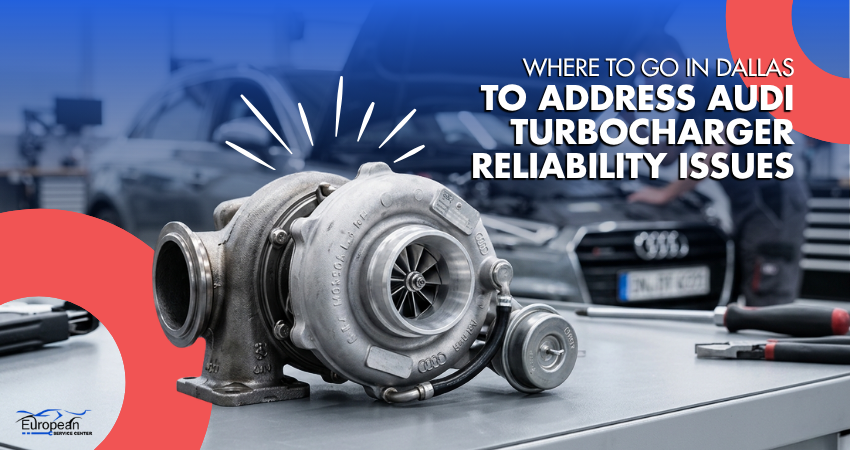
If your Audi is losing power on the Dallas North Tollway, producing blue or gray exhaust smoke, making a whining noise under acceleration, or consuming oil faster than it should between changes, your turbocharger is the first place a qualified Audi specialist will look. Turbocharger reliability issues are among the most common complaints on Audi’s 2.0T TFSI and 3.0T supercharged and turbocharged engines — and in Dallas’s extreme heat, the failure rate is higher than in nearly any other American city.
European Service Center operates four Texas locations serving Audi owners across Dallas, Plano, and the greater DFW metroplex with the manufacturer-level diagnostic equipment and Audi-specific expertise that turbocharger diagnosis and repair demands. If you’re searching for Audi turbo repair near me in Dallas, here’s everything you need to know.
What Makes Audi Turbochargers Fail — and Why Dallas Makes It Worse
Audi’s turbocharged engines — particularly the 2.0T TFSI found in the A4, A5, A6, Q5, and TT, and the 3.0T found in the S4, S5, A6, and Q7 — are precision-engineered components that depend on a continuous supply of clean, properly pressurized engine oil for lubrication and cooling. The turbocharger’s central shaft spins at up to 200,000 RPM, supported by journal bearings that are separated from the housing by nothing more than a thin film of engine oil.
When that oil supply is interrupted, degraded, or contaminated, the bearing surfaces contact the housing within seconds. The damage begins immediately and compounds with every revolution. In Dallas, where summer temperatures exceed 105°F and underhood temperatures during traffic on I-35 or the LBJ Freeway can rise significantly, the conditions for turbocharger stress are extreme year-round.
Symptoms of Audi Turbocharger Reliability Issues Dallas Drivers Notice
Dallas Audi owners dealing with turbocharger problems typically experience a progressive combination of these symptoms:
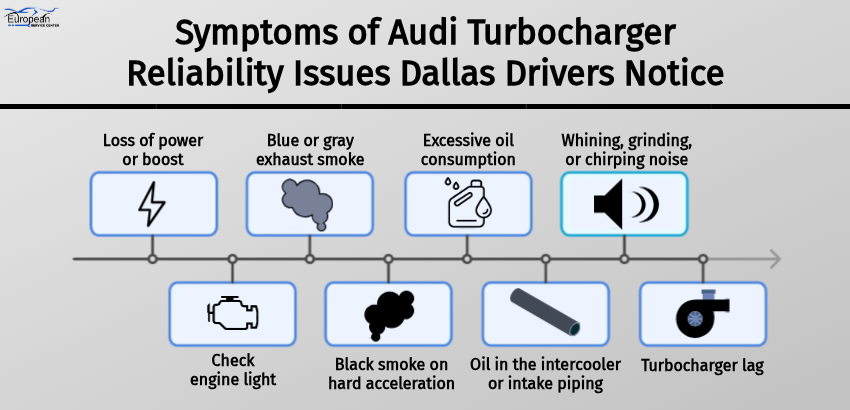
- Loss of power or boost — the Audi feels noticeably slower than normal, particularly during highway merging on I-635 or the DNT, where full boost is needed
- Blue or gray exhaust smoke — oil is entering the turbocharger and burning in the exhaust stream, most visible on cold start or during deceleration
- Excessive oil consumption — burning through oil between changes without a visible external leak as oil passes through the turbo seals
- Whining, grinding, or chirping noise under acceleration — worn turbocharger bearings making contact with the housing
- Check engine light — with boost pressure codes (P0299 underboost, P0234 overboost) or oil pressure-related faults
- Black smoke on hard acceleration — a wastegate or bypass valve fault causing overboost and rich combustion
- Oil in the intercooler or intake piping — turbo seal failure, allowing oil to enter the intake tract
- Turbocharger lag — longer than normal delay before boost builds, indicating worn internal components or a failing wastegate actuator
What Causes Audi Turbocharger Reliability Issues in Dallas
Several factors specific to Dallas and the DFW area accelerate Audi turbocharger failure:
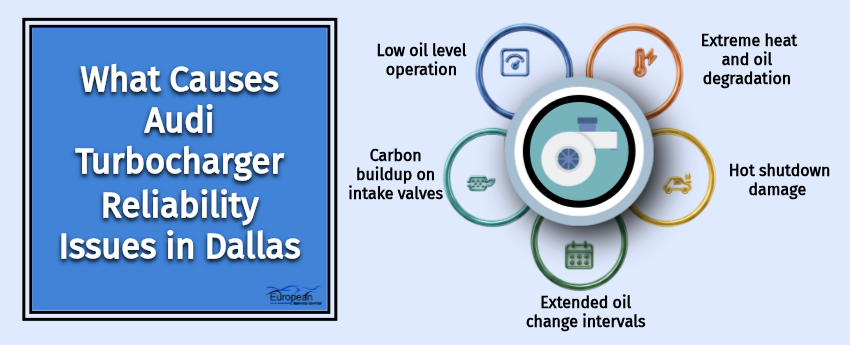
- Extreme heat and oil degradation — Dallas summer temperatures are among the harshest in the country for turbocharged engines. Engine oil in a turbocharged Audi operating in stop-and-go Dallas traffic reaches temperatures that accelerate thermal breakdown faster than in cooler climates. Degraded oil loses viscosity and film strength, leaving the turbocharger’s journal bearings inadequately lubricated during the high-load, high-temperature conditions that Dallas driving consistently creates.
- Hot shutdown damage — turbochargers retain significant heat after the engine is shut down. When an Audi is parked immediately after highway driving on the DNT or I-75 without an adequate cooldown period, residual heat in the turbocharger housing cooks the oil inside the bearing housing, forming carbon deposits that restrict oil flow and accelerate bearing wear. This is called turbocharger coking — and it’s one of the most common causes of premature turbo failure on Dallas Audis.
- Extended oil change intervals — Audi’s oil life monitoring sometimes permits intervals that exceed what Dallas driving conditions warrant. In high-heat environments, oil degrades faster than the algorithm anticipates. Dallas Audi owners who rely solely on the oil life monitor without considering local conditions expose their turbochargers to degraded oil for extended periods.
- Carbon buildup on intake valves — Audi’s direct-injection 2.0T TFSI engine is prone to carbon buildup on intake valves, which restricts airflow and forces the turbocharger to work harder than designed to maintain target boost pressures. The added stress accelerates turbocharger wear on an engine that’s already under thermal stress in Dallas summers.
- Low oil level operation — Dallas drivers who stretch oil change intervals often don’t check oil levels between changes. An Audi 2.0T that’s a quart low on oil provides significantly less lubrication to the turbocharger, creating conditions for bearing failure within relatively short operating periods.
Why Dallas Audi Owners Shouldn’t Ignore Turbocharger Reliability Issues
Audi turbocharger problems that are caught early — before bearing failure progresses — are manageable repairs. Ignored, they become catastrophically expensive:
- Catastrophic turbocharger failure — a bearing that fails completely sends metal fragments into the intake and exhaust systems. Metal particles in the intake reach the engine cylinders, scoring cylinder walls and damaging pistons. This turns a turbocharger replacement into an engine rebuild.
- Catalytic converter destruction — oil burning through a failing turbocharger coats the catalytic converter substrate with carbon and ash. On an Audi with a high-flow catalytic system, replacement is a significant expense that substantially compounds the turbocharger repair cost.
- Intake system contamination — oil entering the intake through failing turbo seals coats the intercooler, intake manifold, and throttle body with a film that reduces airflow and requires professional cleaning to restore correct boost and fueling behavior.
- Texas emissions failure — a turbocharged Audi producing blue smoke or triggering boost-related check engine codes will fail Texas emissions testing, blocking registration renewal until the underlying fault is repaired.
How European Service Center Diagnoses and Repairs Audi Turbocharger Issues in Dallas
Our approach starts with Audi-compatible diagnostic scanning — reading boost pressure data, oil pressure signals, and all stored fault codes — alongside a physical inspection of the turbocharger for shaft play, seal leakage, and housing damage. A turbocharger that has shaft play (detectable by physically moving the turbine shaft) has already sustained bearing wear and requires replacement. One that shows early warning codes without shaft play may be recoverable with a thorough oil service and related maintenance.
Once the diagnosis is confirmed, we provide a clear, itemized estimate covering the turbocharger replacement, the mandatory oil and filter change that must accompany any turbo replacement, inspection and cleaning of the intake and intercooler for oil contamination, and any related component work. Installing a new turbocharger without addressing contaminated intake components or the root cause of the failure — typically deferred oil service — results in premature failure of the replacement unit.
For Audi repair and diagnostics in Dallas performed with manufacturer-level equipment and genuine Audi platform expertise, European Service Center is the shop DFW Audi owners trust.
Why Choose European Service Center for Audi Turbocharger Repair in Dallas TX
European Service Center operates four Texas locations serving DFW Audi owners across Dallas, Plano, and the surrounding metro area. Our technicians work on Audi, BMW, Mercedes, Porsche, Aston Martin, Ferrari, and the full spectrum of European vehicles daily — bringing the diagnostic depth and platform-specific expertise that Audi’s turbocharged engines require.
We back all repairs with European Service Center’s comprehensive warranty and offer transparent, itemized estimates before any work begins. For European auto repair across Dallas and Texas, European Service Center is the independent alternative that DFW’s most discerning European car owners choose.
Frequently Asked Questions About Audi Turbocharger Repair in Dallas
How do I know if my Audi turbocharger needs replacement or just maintenance?
A turbocharger with detectable shaft play, oil contamination in the intercooler, or audible bearing noise requires replacement — those symptoms indicate mechanical damage that can’t be reversed. A turbo that’s showing early warning codes without physical symptoms may respond to a thorough oil service and related maintenance. European Service Center will advise honestly on which applies to your specific vehicle after a proper diagnostic.
How much does Audi turbocharger replacement cost in Dallas?
Turbocharger replacement on a 2.0T TFSI typically ranges from $1,500–$2,500 in parts and labor depending on model year and whether secondary components — intercooler cleaning, intake service, oil lines — also require attention. The 3.0T and larger engines are more involved. We provide a complete itemized estimate before any work begins.
How can I extend my Audi turbocharger’s life in Dallas’s heat?
Three practices make the biggest difference: change oil on schedule using the correct Audi-specification synthetic, allow the engine a brief idle cooldown period after hard Dallas highway driving before shutting down, and check oil level monthly rather than waiting for the warning light. These habits alone significantly extend turbocharger service life in DFW conditions.
Does European Service Center service all turbocharged Audi models in Dallas?
Yes. We service the full Audi lineup including the 2.0T A4, A5, A6, Q5, TT, and the 3.0T S4, S5, S6, SQ5, and Q7 — along with the RS models featuring the 2.9T biturbo V6 and the 4.0T V8.
Schedule Your Audi Turbocharger Inspection in Dallas Today
Don’t let a turbocharger reliability issue turn into an engine rebuild. European Service Center has the Audi expertise, diagnostic equipment, and DFW locations to diagnose and repair it correctly.
Schedule your appointment at europeanservicecenter.com or contact your nearest Texas location. Serving Dallas, Plano, and the greater DFW metroplex.